A Guide to Curling
Introduction
Welcome to Erskine Curling Club and the wonderful sport of curling! These notes are intended to provide a simple guide to the basics of this historic Scottish sport and help those interested in taking up the sport understand how it is played and some of the most common terms used.
History
Curling was originally played by farmers who would slide large stones across frozen ponds in friendly competition during cold winter days. As with all other games evidence for the earliest periods of curling is scarce. But there is little doubt that when the notary John McQuhin recorded a challenge about throwing stones across the ice between a monk at Paisley Abbey and a relative of the abbot in February 1540 the written history of curling had begun.
Erskine Curling Club was formed in 1854 to formalize regular matches which were played on a pond on the outskirts of Bishopton. We have since moved indoors to the Greenacres Curling Rink near Howwood and welcome players from across Renfrewshire and Inverclyde.
The Basics
Curling is a fun and challenging game combining physical and mental skill.
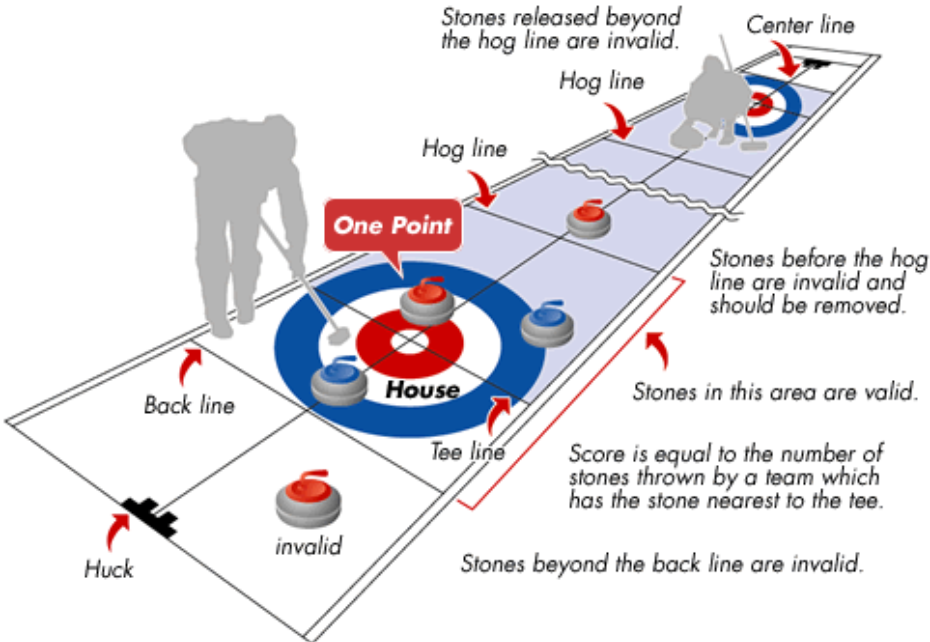
It is one of the few sports where all ages, genders and abilities can play together and against each other. Two teams, usually of four players each, take turns to deliver stones down a sheet of specially prepared ice (45m long, 5m wide) attempting to get closer to the centre of the target or ‘house’ (a set of circles approximately 3.6m diameter), than their opponents.
Each stone weighs 18-19kg and is normally made of polished granite. Each stone has a handle on the top which a player will use to propel the stone down the ice and, with a gentle turn of the handle, to cause the stone to “curl” as it progresses down the ice.
The player “throwing” the stone pushes off from a hack which is embedded in the ice behind the house at one end of the sheet. The player will aim at the brush held by a team mate, often the team captain, who is standing at the other end of the sheet who will also indicate which direction they wish the stone to be turned.
The stone must be released before the player throwing the stone reaches the hog line which is 6.4m from the middle of the house at the end from which the stone is being thrown.
As the stone slides down the ice towards the “house” at the other end of the sheet, two team members can help it in its progress by sweeping directly in front of the stone. This can help the stone go further by making the ice “smoother” and/or help keep the stone go straighter.
Should the stone fail to reach the hog line at the other end of the sheet it is invalid and will be removed. Similarly, if the stone goes past the back line at the rear of the target house it will also be removed.
Once all of the stones have been played the end is complete and the stone or stones which are closest to the centre of the target house are counted and added to the score of the relevant team.
Matches generally last about 2 hours and comprise around 8 ends. The winning team is the team who has the highest score after all of the ends have been played.
Teams
Teams are usually made up of four players who play in the following order alternating with their opposition equivalent:
Lead – the first to play and often asked to play a shot so that the stone stops just in front or at the front of the house. The lead will determine which team plays first by tossing a coin with the opposition lead. Once they have completed their two shots they will then help sweep for the remainder of the team.
Second – the second to play. May be asked to play more shots to the front of the house or try and curl a stone around those played by the leads. Sweeps for the other players’ stones.
Third – Plays in third position sweeping for the lead and second shots. Will also usually take over from the skip to indicate where the stone is to be played when the skip is delivering their stones.
Skip – usually the captain of the team and is responsible for the overall strategy of the team. They will stand in the house and indicate where they want their team mate to play their stone covering direction and strength of shot.
Types of shot
Shots can be described as follows:
- Guard – a shot which stops in front of the house protecting an existing stone within the house or providing the opportunity for a future stone to “draw” round it into a protected position
- Draw – a stone which curls around other stones into a protected position or closer to the centre of the house or “button”
- Hit or take out – a strongly thrown stone aimed at removing other stones. These may also be referred to as having “hack” or “barrier” weight which refers to the back of the house and therefore where the stone is expected to reach
- Hit and roll – a stone which is expected to it another and then to gently roll across into a good position
Equipment
Equipment required to play curling will be generally available at the ice rink and comprise of the following:
Shoes
For beginners, general training shoes can be used but MUST be clean so generally will NOT be those which a player wears to the ice rink. To allow a curler to slide when playing a shot a “slider” can be purchased or hired to slip over one of the shoes.
Specialist curling shoes can be purchased which will comprise of one with a grippy sole and the other with an inbuilt slider over which a gripper can be fitted to improve grip when not playing a shot. The selection of specialist shoes should be done carefully as they can be expensive.
Brushes
Most often available at the ice rink, but can be purchased from specialist sports shops or on the web, a brush is used to sweep in front of the stone. Players will often agree which one will sweep closest to the stone with the other a little further forward.
It is critical that a player who is sweeping maintains a good balance moving comfortably in front of the stone. A player should NEVER chase a stone which is travelling away from them down the ice.
Curling Stones
Supplied by the ice rink these will have numbers or letters on them and are paired to ensure that the player has a consistent weight and curling bias (i.e. how quickly the stones curl) to their stones.
Gloves
Not essential but often helpful in keeping hands warm and also to provide better grip on stones and brushes.
Trousers
Again not essential but players often find that should they rest their knees on the ice when playing a stone they will find a patch of wear on their knee which is challenging to remove. A dedicated pair of trousers for curling is therefore recommended and specialist pairs are available with stretchy material to enhance flexibility and warmth.
Cost
The cost of curling comprises club memberships and the cost of hiring the ice to play on. For season 2025-26 these are:
| Organisation | £ pa | Covers |
| Erskine Curling Club | 30.00 | Club administration including trophy insurance |
| Greenacres Curling Club | 45.00 | Access to Greenacres facilities (not ice fees (see below)) |
| Scottish Curling | 31.00 | Membership of national body incl. playing insurance |
| XIIth Province | 2.50 | Regional competition administration |
In addition to the above annual costs, the hiring of a sheet of ice for 2 hours is £20 per person.
Finally a member of a winning team is expected to buy their opposition team member a refreshment after the match has completed where facilities are available.
Etiquette
Curling is a game of skill and traditions that upholds the highest standards of sportsmanship. A shot well played is a delight to see as is a game played in the true spirit of curling. Curlers play to win but never to humble their opponents.
Curling has always relied on the common sense, honesty and the good manners of the players and a sporting approach to the game. While the main object of the game of curling is to determine the relative skill of the players, the spirit of curling demands good sportsmanship and honourable conduct.
For safety:
- Ensure nobody is standing in a position to be hit by your brush or stone when you are about to deliver
- Use your brush to stop stones, using your hands or feet can result in injury.
- When clearing stones from the house, avoid walking in front of moving stones
- If a stone is in danger of hitting someone, shout the warning ‘ICE’
- Do not lift stones
- Finish your slide before standing up
For consideration to others:
- Do not disturb a player in the hack; remain quiet and outwith his / her line of vision
- When your opposition is playing, stand at the side of the rink, between the hog lines
- Never cross the ice in front of a running stone
- Only skips and acting skips should be in the house at any time and they should keep their brushes hidden when the opposition is playing
- At the finish of an end, only the acting skips should be in the house until a score is agreed
BUT ABOVE ALL ENJOY YOURSELF AND HAVE FUN!!